

Aire went to meet Tristan Gesret. He is a sign painter craftsman. In addition to doing exceptional work, he deserves credit for learning this trade on his own. We are happy to highlight a talented French craftsman.

Can you introduce yourself and your sign painting activity?
My name is Tristan Gesret and I am 32 years old. I am Breton and I live near Vannes. I have been a sign painter for 3 years.
I have an unusual background. I was not at all destined for an artistic career. I never knew what to do. So I listened to my parents. I took a science baccalaureate. And I went into medicine because there were many job opportunities.

Afterwards, I worked in real estate. I even obtained a degree in real estate law. Then I got fed up, so I had some experiences on my own like traveling. Then, four years ago, I discovered sign painting by chance. It was a revelation and I threw myself into it completely.
Is the sign painter’s profession art or craft?
I consider myself a craftsman. There is a lot of theoretical learning such as letter sizes, proportions, typography, color combinations… I don’t give up on my projects.
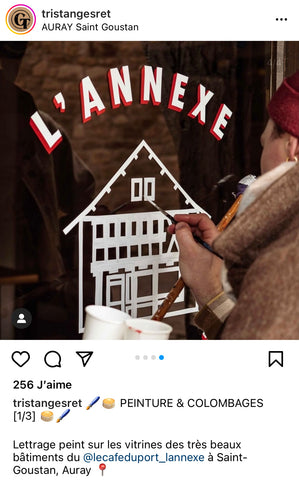
Besides, I make signs, so I work a lot with wood.
Where are you currently with your projects?
Since I started out alone 3 years ago: it has grown. Quite quickly. My girlfriend joined the company. She manages communication. That’s why we are productive on social media. We also have a part-time employee who is a graphic designer. That lightens our workload. Because in the end, we have a lot of work to do on the computer. Many people glorify the sign painter’s craft. But even if we excel, we can’t do without the computer. So we use it to make mock-ups, overlays, and many other things.

In the past, the restaurateur would call the sign painter, then he wanted the word restaurant written on his facade. Possibly with a specific color. Then the sign painter would directly create the lettering, with a small sketch.
Now customers are more demanding. Moreover, today, there are requests to be made to APS, architects of historic buildings, or other people. So you have to make several proposals on the computer, several mock-ups, the exact dimensions, find the right color. As a result, it takes more time than before.
Today we have a small workshop at my place, in an outbuilding. It’s very small so we get overwhelmed quickly in the workshop. But, starting next fall, we’re moving to a 200 square meter workshop!

As for the workshop’s projects, we work all over Brittany, the entire Grand Ouest. Our projects are quite varied, I can paint for restaurants, schools, shops, bars, institutions, or even individuals who have vintage vehicles.
What was your biggest challenge as a letter painter?
One of the projects that made me known is: a facade that is 9 meters high and 6 meters wide.
I had just started letter painting so I wasn’t very comfortable yet. Then it’s impressive to face such a big wall. But we succeeded. We went all the way, and we were happy. We really want to develop this type of project. Painting on large facades like back in the day in Le Havre. I really hope it comes back into fashion! I’m convinced it will.
Especially in an era where everyone takes pictures of everything, everything goes through images. It would be great if a company started communicating like that, it would create huge buzz. But unfortunately, it costs more than a billboard.

That’s part of my future challenges. I’m ready to travel all over France to convince a company to do this.
After that, we did another cool project. It’s the Grain de Sail boat. It’s chocolate sold in supermarkets. They created the first transatlantic cargo sailing ship that goes to South America to get cocoa. And they return to Brittany by sail to take part in the French market. So, there’s an eco-friendly approach thanks to a low carbon footprint.

They asked me to paint the name of the boat. I was on a swing with ropes above the water. It was impressive. Plus, there was wind. I had to manage to stabilize myself. I think I’ve never had so many aches after a job.

Your favorite tools?
In terms of equipment, it’s really very varied. When tackling large facades, we use big, very pleasant brushes. I use edging brushes. I’m really starting to love this brush. Then there are also flat brushes and small spalters.
However, for small signs that require precision work, we use sable hair brushes. These are very long, soft natural hairs. You really have to take care of them. They allow you to hold a large amount of paint to make long strokes without breaks. The goal is to make as few strokes as possible.

In my left hand, I have a cane, and in my right hand, I have my brush. My right hand rests on a cane that I hold with my left hand. It helps me stay stable, and it’s my left hand that moves the cane to make more precise strokes.
How do clients approach you?
They use Instagram a lot; now we can’t do without it. Then there’s also quite a bit of word of mouth. As soon as we arrive in a new street, since the work is visible, the shopkeepers spread the word.
What step does a project start with?
I ask, “What are your expectations?” I want to understand the style to offer my advice. We suggest typography, effects, and colors that match the desired style.
Now there is a graphic charter that is present almost everywhere and must be respected. It represents two-thirds of the projects. In this case, we adapt the graphic charter to the facade.

And ultimately, I like projects that start with a style as much as those with a graphic charter. Because projects where you have to create an entire universe are very energy-consuming. And in reality, I wouldn’t have time to do only that. Plus, reproducing a graphic charter exactly is quite a challenge. It also allows me to work with graphic designers who are truly talented.
Honestly, I like having a free rein from time to time.
How is a project organized?
We are very organized to avoid wasting time. We start with an on-site meeting with the client. You have to immerse yourself in the place. Because it’s not just “painting a facade.” It has to fit into the street and the architecture. So you need to fully understand the client’s expectations.

We make small hand sketches until we understand what the client wants. Then, we provide regular updates on the project’s progress. This allows us to validate each step. We can’t deliver a finished project if it doesn’t suit the client.
How does a project end?
My job is great because generally we share the same way of seeing things with clients. It’s a different mindset because it involves a financial commitment from the client.

We very often meet friendly, open-minded clients. What’s impressive is that we sometimes develop friendships with clients. We reach the end of the project, so it’s usually the finishing touch. Clients are often delighted, they have no ongoing work and are ready to open! It’s good vibes.
Are there difficult aspects to the job of a letter painter?
Yes, and it’s important to emphasize that. I’m in high demand for internships because many want to become foremen or something similar. It’s a bit of the Instagram problem. Everything looks beautiful, everything is staged. Whereas in reality, there is a lot of preparation work, and the climate in Brittany is humid and cold.
Sometimes you have to travel miles or climb scaffolding. Stay for several hours in front of a facade painting small letters.

It’s a job that requires patience and physical effort and where you must not lose concentration.
I take on as many interns as possible because it’s important to show the challenges of the job.
Do you have any fears in your profession?
I’m always afraid of not succeeding. I still have a lot to learn. There are no longer any letter painting courses available. So I’m self-taught. That’s why I’m never 100% confident. Despite that, it always goes well. But I always have this fear of messing up my stroke. Thanks to my experience, I’m becoming more and more comfortable. And once I’m on site, the fear quickly fades.
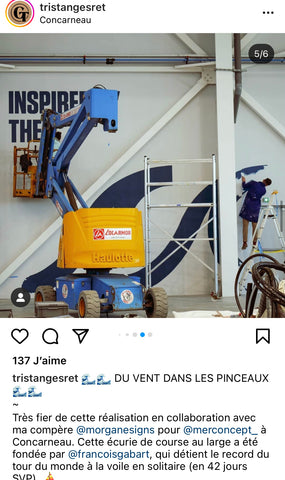
When I start painting I enter into symbiosis with my brush. I am almost meditating. Time flies by and I clear my mind.
Do you have any Instagram accounts to share?
@siclone_
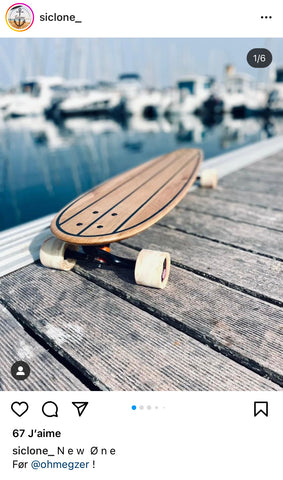
He is a carpenter who creates surfboards, skateboards, and cutting boards for restaurants. I work regularly with him. In fact, he is almost my neighbor. We live only 500 meters apart as the crow flies. We mainly collaborate for brands.

David is a craftsman who lives in the same town as me. He is a luthier. His talent has earned him several awards. He loves his job and is truly passionate.
Feel free to take a look at our latest article: Houbly and their bio-based materials
0 comments