

He is the official designer for the AMPM brand and Poliform, an international brand, among others. But he is also an artistic director, professor, lecturer, and workshop facilitator.
Meeting with an extraordinary designer who brilliantly combines humility and talent… No “me, myself” with him, but rather the spirit of a team and a deep awareness of the responsibility to create furniture for people, whether clients or manufacturers, while preserving the environment.
Quite a program.

First of all, how did you come into the world of design? Was it a long-standing vocation or did it happen by chance?
Since I was little, I’ve loved drawing, painting, making objects. I had an Italian grandfather who was a tailor and lived surrounded by his creations and drawings that fascinated me. So after high school, I joined Fine Arts where I quickly realized I had a particular interest in artistic creation. It was linked to functionality. Design then appeared to me as a discipline perfectly suited to me because it combines art and functionality. I then joined the National School of Decorative Arts in Limoges. Which greatly liked, it’s this first link with industrial production. For most pieces, plaster molds were made to then have a series production of objects.
Can you tell us more about your roots? Because on your website, we see that you are present both in France, in Bordeaux, and in Italy, in Milan? So your roots are double?
I grew up in Périgord, which is a region of terroir par excellence. I think it’s important in our professions to be well rooted in traditions. When I create an object, I look a lot at the past, tradition, the objects from certain historical periods and I try to reinterpret their codes. After studying Fine Arts, when I realized I wanted to do design, I quickly went to Milan. I understood early on that if I wanted to do design at a certain level, I had to go to Milan, the world capital of design. I went there to finish my studies and then was able to join design agencies. That’s where I created my first agency.
I lived there for twenty years and I still split my time today between Bordeaux and Milan.
So, there is a true cultural duality in me between the Périgord and Italian cultures. It’s a big advantage because Italians really appreciate the “French” artistic approach that brings a certain sensitivity, and we, as designers, greatly benefit from the expertise very present in northern Italy, where the industrial fabric is very strong.
Precisely, what are the differences between French and Italian design?
There are striking differences. Italians have design in their DNA, you could say, and this has been the case since 1945. It was at the end of the Second World War that brands like Flos, Artemide, Zanotta began to emerge. Or even Piaggio, which like many Italian brands, comes from the arms industry. Piaggio used to make airplane wings. These artisans and designers have been able to use, redirect, and transform technology to produce objects that are still iconic today, like the Vespa, for example.
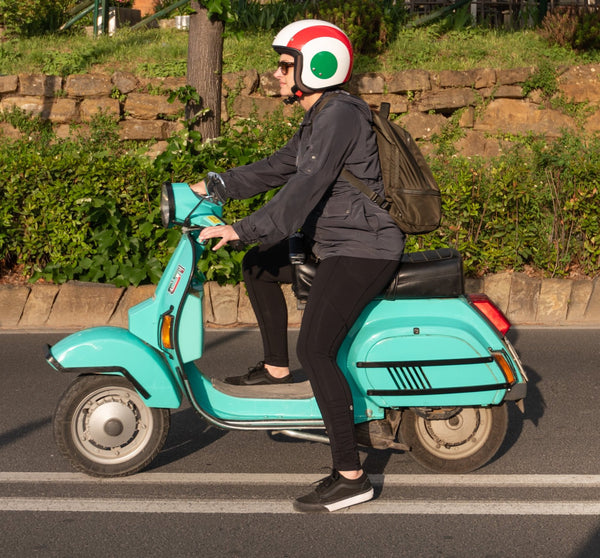
In Italy, they have managed to keep a know-how very present since that time when in France, we lost it especially in furniture. It still persists in luxury with brands like Vuitton or Hermes, but otherwise our know-how has been largely lost across the French territory. Even though in recent years, we have been trying to catch up a bit, we are seeing a boom with small emerging brands or also with personalities like Philippe Starck.
In France, we have long kept interiors inherited from our parents and grandparents where decoration had no place. This interest is very recent, whereas in Italy, it has almost always existed.
But I find there is still a huge gap between Italy and France, especially in terms of design and decoration culture. Italians are much more cultured; they know the brands, the designers. In France, you are already speaking to an elite when you talk about certain brands or designers. That’s where the difference lies. Design is part of Italian culture. Italians love beautiful things.
Can you describe your creative process and your way of working when you create a new object?
There are several scenarios, either it’s a client brief, although I prefer to speak more of partners and even friends because there are some I have been working with for nearly ten years. A great trust has been established between us over the years.
It’s true that on one side there is the designer and on the other the brand. You have to be able to understand each other perfectly, and when the collaboration has lasted more than ten years, the bonds are very strong. That means we understand each other perfectly.
As a creator, I truly dedicate myself to the brand, to its identity, trying to bring it towards a vision we share. It’s a real team effort. Like with AMPM, for example, with whom I have worked for over ten years. It’s true there is a real climate of trust and we try to elevate the brand in terms of quality, innovation, and design. For that, I perfectly align with the vision of the brand’s artistic director. The same in Italy where I work with Poliform. Either they have specific requests, or the trust created working with the brand allows me to make proposals based on intuitions or gaps we may have felt. I also know what I can bring to them.
On a personal level, I have reflexes and approaches where I work on fluid, rounded shapes but not soft for all that. “I like to round the corners” as I often say.

What do you think Decoration is for?
As I said, in my way of working, there is a certain softness in the shapes because I seek to bring objects into the home that will create a certain well-being. Italians have this culture of good living more than we do. Even if it’s starting in France. Yet, a piece of furniture, an object must contribute to well-being and be able to fit into all lifestyles.
In design, what will be the most important?
I try to remove the superfluous to keep the essence of what we want to convey. Working on details to give meaning to the objects we put on the market. Because there are already many objects on the market, so when we add one, we want it to have a strong reason to exist.
The other direction for us is also to create “timeless”, which will not rely on fashion or current trends. These products will have the strength to endure over time. Today, there is a lot of talk about sustainable development. This approach will not only concern materials. Even though, of course, we work with recycled and recyclable materials. But we really want to offer users, customers who buy our products, objects which, in ten years, will not go out of style. I hope these objects will have an essentiality and simplicity such that trends will not make them obsolete. It also involves high-quality, noble, and rich materials that contribute to durability. Working them with shapes that are not too overwhelming will make them timeless.
What is the piece of furniture or object you prefer to design?
I have a slight preference for the chairs. For designers, they always represent a challenge. It’s an exercise I willingly engage in because it’s the most difficult. It involves many constraints, both ergonomic and functional. Today, we also have many new technologies and innovative materials.

It’s an object I enjoy working on. I’m lucky to be able to design anything and everything. There is always something to discover in new typologies. Which always makes me very enthusiastic.
For example, even though I specialize in housing, I am increasingly led to work with the development of flex office and on the new ways of organizing offices. These new lifestyles will therefore require new objects, adapted to these new modularities.
We bring our know-how from the home into the office world with objects of different typologies.
Your product, the Pegboard, fits into this universe and is a perfect example. It’s an innovative object, on the border between home and office, that can travel from one universe to the other.
People who inspire you?
These are more historical periods that inspire me rather than specific people per se. The thirties and forties, primarily because they mark a real turning point. It’s a pivotal period where a very rich decor was traded for clean and minimalist interiors. While maintaining a certain quality of materials. We can mention Pierre Chareau and Jean Michel Franck. As well as the modern movement of Le Corbusier. What I appreciate is that they managed to move towards something minimalist while keeping the richness of certain materials. I am very attentive to this period from which I draw a lot of inspiration.
The sixties as well, whether in Italy, the United States, or Scandinavia, these are moments of very strong innovation for furniture. I pay special attention to people like Gio Ponti in Italy, like Hans Wegner for the Scandinavian countries and the American couple EamesI follow current trends much less because they distract me a bit too much. I prefer to study and delve into books about these periods. I am currently reading Laure Adler’s book on Charlotte Perriand. I was lucky to meet her. She is a person I really appreciate and I love the pieces she was able to create during her career. Jean Prouvé as well. We actually started a collection referencing this universe. Once again with the aim of bringing well-being, soft shapes, natural and warm materials.
It’s more in the past that we find our inspirations. The idea is not at all to copy but to understand what makes these objects so interesting, so profound, so timeless. It really feeds my inspiration and my creation. Even though I still look at what young designers are doing.
But I won’t hide from you that people like Gio Ponti, Jean Prouvé, Charlotte Perriand, I never get tired of looking at what they did and why they did it!
You wear many hats. You’re not only a designer but also an art director, professor, speaker… Which role do you prefer?
My special moment is in the morning when I make small sketches, which bring my reflections and ideas to life. Usually, it’s the moment when I arrive at the office and no one is there yet. I get lost in my thoughts and it’s very relaxing. It’s one of my favorite moments!
But when I give conferences, interviews, or lead workshops, I can talk about my passion and I love that, being able to exchange ideas. It’s something that gives a lot of satisfaction; the exchange.

Art direction allows you to move from the “student” mode, who only cares about their art, to a much broader understanding of all the factors, all the constraints, all the players in the profession that come into play in the creative process. We are a kind of conductor, and it’s very interesting to work with engineers, marketing people, communication specialists. It’s almost another profession but also very enriching. You have to rise much higher and see the project globally.
I truly believe that to be a good designer, you have to be able to integrate all these market constraints. The smallest chair will not just be a chair but will represent a brand. The product will be intended for a certain market, certain countries. A chair will also become the work of the people who work for the company, and out of respect for these teams, we cannot afford to make mistakes. The designed product will contribute to the brand’s aura, sometimes even to its survival. We have a great responsibility towards this entire chain.
You have received 14 awards, no less! That’s an impressive record, what does it mean to you? Is it important or quite relative?
Sure, we’re happy when we win an award but that’s not really what I’m looking for. It’s not very important to me. It’s more the human relationship I have with my partners who have become friends over time that is crucial. It gives me much more satisfaction to know that my partners are successful, that a new showroom opens in China.
What are the current trends?
I can give you the trends. However, we go in the opposite direction. Our role is precisely not to follow them but to create them. The ones we don’t follow, for example; caning, extreme curves in sofas, modular systems in sofas, boucle fabric.
Our role as designers is really to bring novelty. When there is a trend, we try to go in the opposite direction.

Otherwise, I like the natural weaving we have worked on for a long time, and I am currently working on old velvets of very good quality.
I saw on your site that you hold conferences all over the world. Are there different trends emerging depending on whether you are in Brazil or China?
You could say that with the Poliform brand, known worldwide and distributed almost everywhere, you can’t go wrong because we have to offer products that will appeal to the greatest number in China as well as Brazil. I must admit we are witnessing a certain homogenization of styles worldwide. At Polyform, for example, the style aims to be timeless, elegant, and not ostentatious. We see that this is very popular and meets strong demand, especially from the Chinese who have evolved a lot in taste over the past ten years and increasingly tend toward this refined contemporary minimalism. They seek simple eleganceThese are products with meaning and a fairly strong cultural level. I think it’s good that China is interested in this; it shows it is evolving a lot and very quickly.

Do you have a favorite object from a famous designer???
More than objects, I look at brands. Yes, there is a designer Christian Liegre and in this case, it’s his materials that captivated me. He really manages to bring a subtle dimension by reworking materials.
Your latest musical favorites?
I recently enjoyed listening to Daft Punk again and I’m trying to convert my children to a more poetic rap than what they’re currently listening to; like MC Solar’s. Otherwise, classical music soothes me a lot. But when I draw, it’s usually in silence.
In cooking, do you have a favorite dish? And will it be Italian or French?
Italian of course! Risotto and pasta and As in Design, these are extremely simple dishes but for which the quality of the ingredients is crucial.

A website to share even if you have little time to browse?
I really like a site managed, I believe, by NASA but whose name I’ve forgotten, which offers photos of Space or the Moon, and I must admit it fascinates me, it’s magical.
A motto to share ????
“Simplicity as resolved complexity” Constantin Brancusi
Photo credits Emmanuel Gallina Design Office
Interviews conducted by Edith SELLIER PASCAL
0 comments