

The lungs of the planet, the forest is home to many animals and plants. Did you know that a handful of forest soil contains more living organisms than there are inhabitants on Earth? Faced with the progression of deforestation, sustainable forest management is a necessity. The PEFC NGO has been working since 1999 to preserve the forests of France and the world.
What is sustainable forest management?
Developed at the Earth Summit in Rio de Janeiro in 1992, sustainable forest management is inspired by the concept of sustainable development, widely disseminated by the Brundtland report. The Rio Declaration on Forests brings together international aspirations and recommendations for sustainable forest management.
This concept of sustainable forest management establishes a vision for our forests, capable of providing people with the goods and services they expect without impacting their future. Thanks to these conditions, we can hope to bequeath to future generations an environment that they too can enjoy.
In Europe, sustainable forest management must respect five criteria defined at the Helsinki Conference (1993):
- Conservation and enhancement of forest resources (maintenance of production capacities)
- Maintenance of forest health, their good sanitary condition
- Fulfillment of the production function (wood and non-wood products)
- Respect for biodiversity in forest ecosystems
- Protection of soil and water
Sustainable forest management is a global ambition, although it is not applied by all countries. In France, the Ministry of Agriculture, Agrifood and Forestry ensures its proper application.
Why is it necessary to manage forests sustainably?
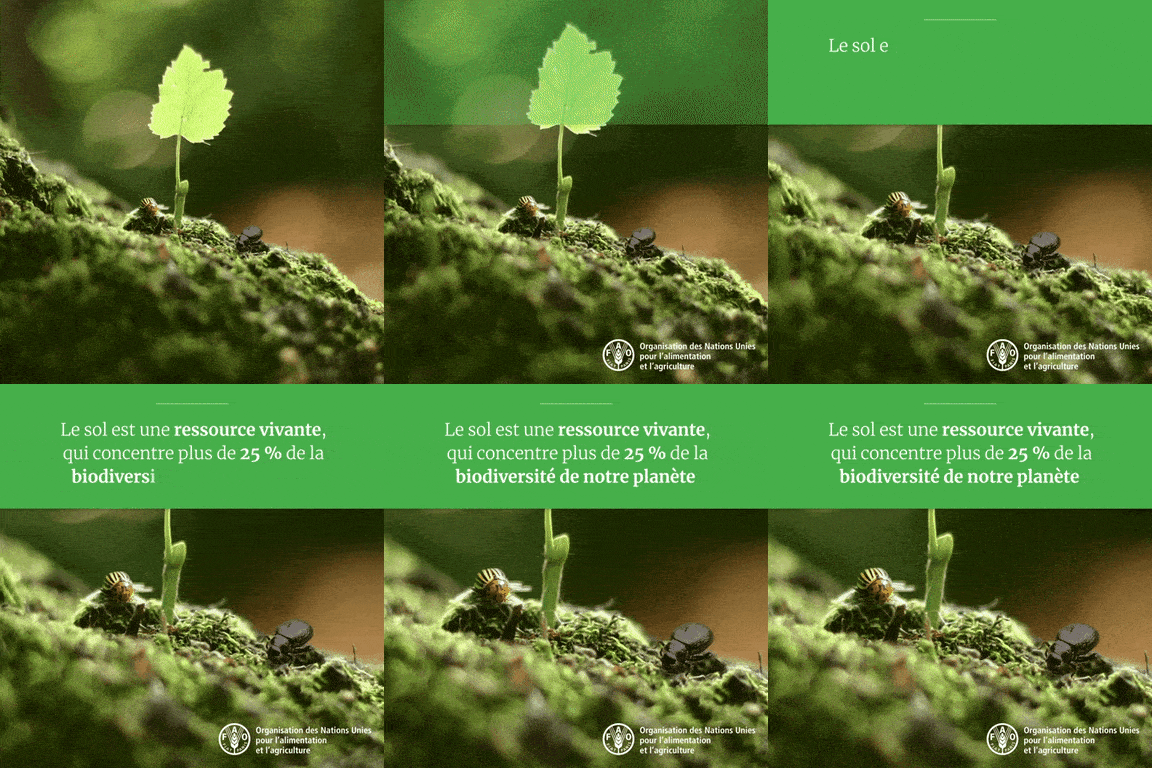
A handful of forest soil contains more living organisms than there are inhabitants on Earth. This gives an idea of the biodiversity we have to protect.
Globally, forests cover more than 1/4 of the Earth's land surface.
Two-thirds of all recorded terrestrial animal and plant species live in forests.
On Earth, 300 million people live in forests and 1.8 billion depend on them directly for their subsistence. A forest where several species coexist is more resistant to diseases and climatic hazards.
A true carbon sink, forests store 30% of global greenhouse gas emissions.
Diversity is also beneficial to living organisms, under the tree canopy and in the soil. To protect or develop this biodiversity, it is important to take care of the soil by ensuring its supply of organic matter.
Forest biodiversity threatened!
Despite their crucial role, forests continue to lose ground: while in 1990 they covered approximately 4.128 billion hectares, in 2015 they only covered 3.999 billion hectares, or 30.6% of the land. Some 129 million hectares of forest - an area almost equivalent in size to South Africa - have been lost since 1990.
According to satellite data from the United Nations Food and Agriculture Organization, an area of Amazon rainforest the size of a football field is now cleared every minute. Deforestation can happen rapidly, for example when a fire sweeps through the landscape (as was the case in Brazil) or when the forest is clear-cut to make way for an oil palm plantation.
While deforestation appears to be declining in some countries, it remains at an alarming level in others - including Brazil and Indonesia - and poses a serious threat to the most valuable forests on our planet, according to the WWF.

Concretely, what actions are being taken to achieve this?
The general idea is to preserve the existing capital of our forests by respecting two main rules:
- Do not cut down more than the natural growth of forests;
- Replace adult generations of trees with young generations.
This requires a long-term planning system to know what to harvest, where, and when.
Let's take the example of France: Each of the 17,000 French public forests has a management plan lasting 15 to 20 years. It establishes the guidelines, forest by forest, for the actions to be taken to respect these rules over time.
More concretely, if we are not sure of recreating an adult forest behind the one we want to cut down, we will not cut it down!

In France, little planting is done. Natural regeneration is favored, which consists of supporting natural seeding by seeds falling from trees to the ground. When there is a sufficiently dense carpet of young shoots on the ground, the trees above are then cut to begin a new cycle. In some cases, artificial planting is necessary: all large trees are first cut down before young plants raised in nurseries are installed.
Aire is committed to the development of sustainable forests
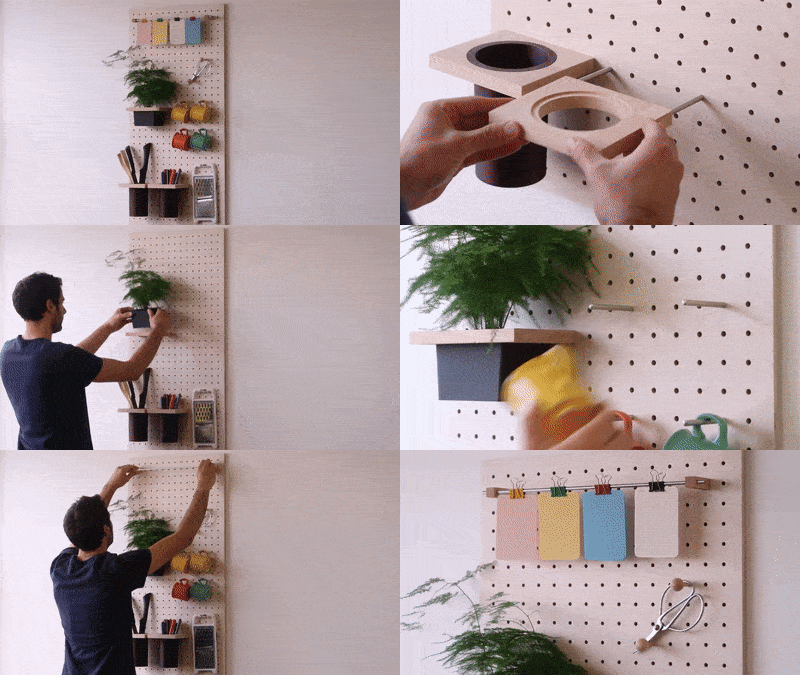
At Aire, we are committed to sustainable solutions. Our strategy of local and sustainable production is at the heart of the creation of our Pegboards. At Aire, our development strategy contributes to the creation of an environmentally friendly and inclusive society.
We source only wood from sustainably managed forests. Our production line is not PEFC certified due to the cost of obtaining the certificate. Nevertheless, we attach the utmost importance to the origin of our raw materials. We are therefore exploring all available possibilities to integrate circular economy materials into our production line.
As you might expect, at Aire, sustainable development is a priority! We are committed to local stakeholders. Aire contributes to operational solutions to accelerate the implementation of the ecological transition at the local level and to show that national objectives are achievable.
For companies that commit, it means integrating all dimensions of sustainable production into their businesses and daily practices. Let's bet that this type of company will become the norm of tomorrow.
A great challenge… That of choosing responsible growth for one's company.
At Aire, we are involved in a model of sustainable creation. We feel the world moving and we want to support it in a viable model for future generations.
Join the Aire universe by following us on Instagram. You will discover the behind-the-scenes of this beautiful adventure!
See you soon
0 comments